Graph Attention Networks for Detecting Epilepsy From EEG Signals Using Accessible Hardware in Low-Resource Settings
Abstract
Speaker: Alessandro Crimi
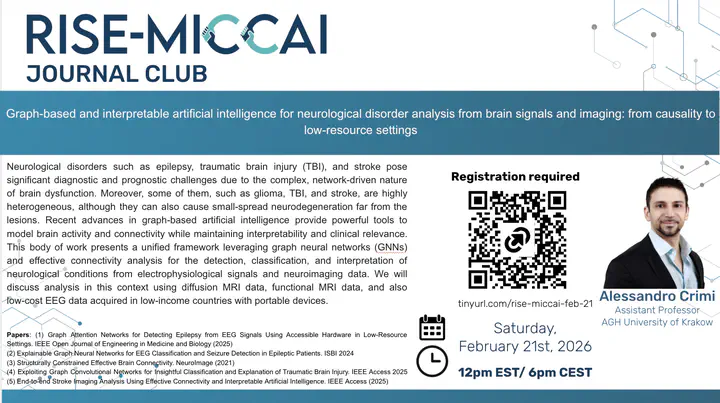
Neurological disorders such as epilepsy, traumatic brain injury (TBI), and stroke pose significant diagnostic and prognostic challenges due to the complex, network-driven nature of brain dysfunction. Moreover, some of them as glioma, TBI and stroke are mostly heterogenous although they also cause small spread neurodegeneration far from the lesions. Recent advances in graph-based artificial intelligence provide powerful tools to model brain activity and connectivity while maintaining interpretability and clinical relevance. This body of work presents a unified framework leveraging graph neural networks (GNNs) and effective connectivity analysis for the detection, classification, and interpretation of neurological conditions from electrophysiological signals and neuroimaging data.
About the speaker: Dr. Alessandro Crimi is a biomedical engineer and health economist who alternated his career between neuroimaging and healthcare management in low-income countries. He is currently a Professor at the Computer Science faculty of AGH University of Krakow coordinating the course machine learning for neuroimaging and neuroscience. After completing his studies in engineering at the University of Palermo, he obtained a PhD in machine learning applied for medical imaging from the University of Copenhagen, and an MBA in global healthcare management by the University of Basel. Alessandro worked as post-doctoral researcher at the French Institute for Research in Computer Science (INRIA), Technical School of Switzerland (ETH Zurich), Italian Institute for Technology (IIT), and University Hospital of Zurich. The post-doctoral years at European institutes were alternated by periods living in Ghana and other sub-Saharan countries, where Dr. Crimi taught and carried out in-field projects about healthcare management. He taught for eight years at the African Institute for Mathematical Sciences (AIMS) in Ghana and South Africa.